 Brand Banao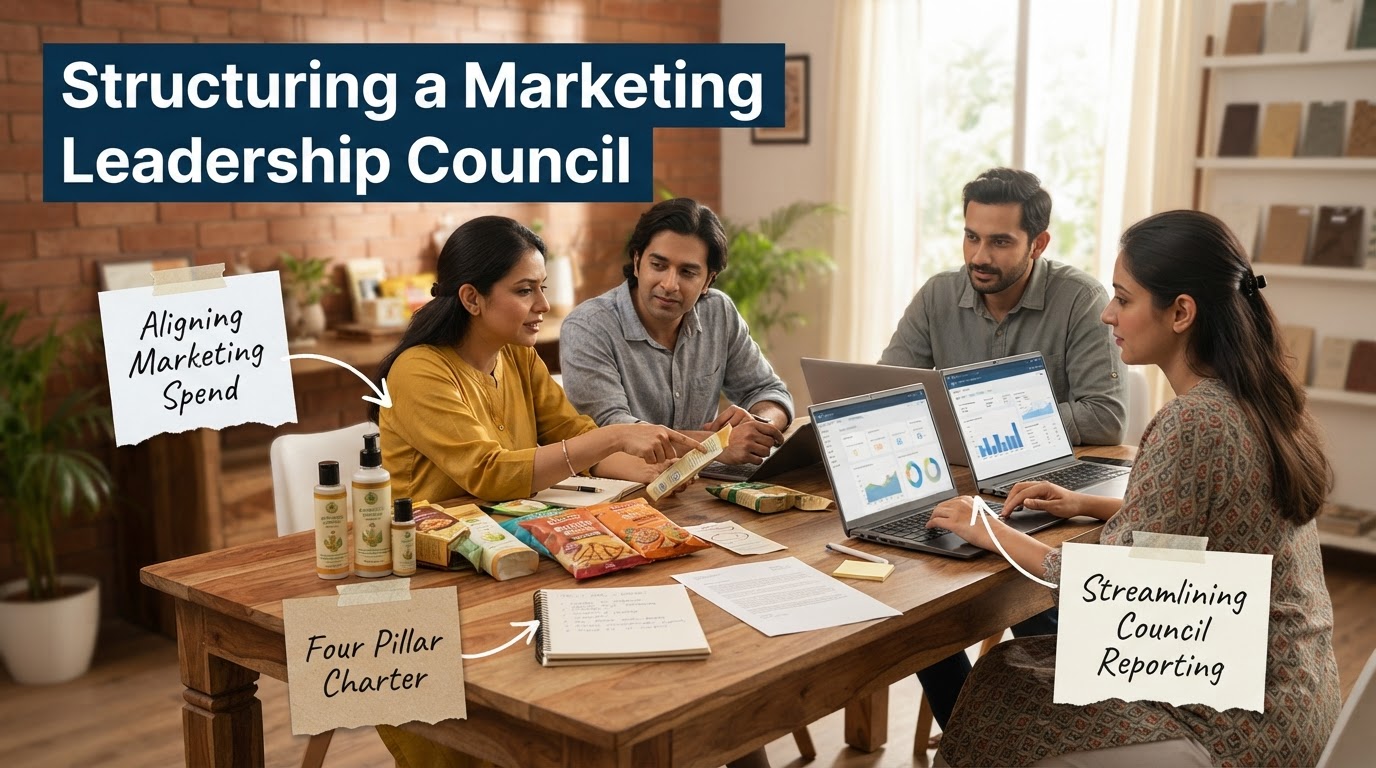
Marketing Leadership Council: How Growing Businesses Can Structure Marketing Strategy and Governance
What Is a Marketing Leadership Council?
A marketing leadership council is a cross-functional steering group that sets strategic direction, evaluates channel investments, and aligns marketing goals directly with broader company revenue targets. Rather than managing day-to-day tactical tasks, this council functions as an internal advisory board that brings clarity, discipline, and accountability to a company's promotional and brand-building activities.
In many growing businesses, marketing discussions happen on an ad-hoc basis or get buried within tactical daily standups. Daily marketing meetings typically resolve urgent questions: reviewing social media copy, troubleshooting a pay-per-click ad set, or organizing an email campaign. In contrast, a marketing leadership council steps back from immediate deadlines to examine macro-level performance. The council evaluates customer acquisition trends, reviews quarterly budget distributions, assesses technology needs, and verifies that messaging reflects the company's long-term commercial positioning.
Establishing this structure does not require corporate bureaucracy or large committee rosters. For an expanding business, a marketing leadership council typically brings together four essential viewpoints: executive leadership, marketing direction, sales or client management, and product or merchandising leads. The executive lead brings the overarching commercial goals and financial limitations. The marketing lead presents channel data, brand assets, and campaign ideas. Sales leads highlight customer feedback and pipeline needs, while merchandising or operations leads track inventory availability and fulfilment realities.
By uniting these distinct perspectives into one recurring forum, the council ensures that marketing ceases to operate in an isolated silo. Decisions shift from instinct-driven guesswork to structured, collaborative business planning. This governance model provides founders and business operators with a reliable framework to evaluate growth initiatives objectively without losing operational agility.
Why Growing Businesses and D2C Brands Need Structured Marketing Governance
As digital brands and direct-to-consumer businesses scale, operational silos naturally emerge. Marketing teams push to drive immediate traffic, product teams focus on releasing new items, and inventory managers battle storage capacity. Without structured coordination, these departments operate at cross-purposes, resulting in wasted ad budgets, fragmented brand messaging, and miscalculated revenue expectations. A structured marketing leadership council provides the governance necessary to prevent these costly friction points.
One of the most frequent points of failure in growing enterprises is the disconnect between customer acquisition costs and actual unit economics. When marketing teams pursue growth targets in isolation, they may allocate heavy capital toward aggressive customer acquisition without visibility into gross profit margins, inventory constraints, or post-purchase retention. A marketing leadership council forces marketing expenditures to map directly to business revenue benchmarks, ensuring that every rupee spent supports profitable, sustainable scale.
Furthermore, modern marketing requires managing multiple automated channels simultaneously, including organic search, performance ads, social commerce, and direct messaging. When these touchpoints operate without shared leadership oversight, customers receive contradictory discounts, mixed messaging, and inconsistent brand experiences.
Hypothetical Example: Consider an expanding direct-to-consumer apparel brand preparing for an upcoming seasonal festival. In this hypothetical scenario, the performance marketing team planned an aggressive paid ad campaign targeting a newly designed jacket line, allocating forty percent of the monthly ad spend to this collection. Concurrently, international shipping disruptions delayed fabric arrivals by three weeks, a fact known to the supply chain team but not communicated to marketing. Through a scheduled thirty-minute marketing leadership council check-in, the operations lead raised the delivery bottleneck. The council immediately redirected the promotional budget toward in-stock knitwear, preventing substantial ad spend waste on backordered items and protecting customer trust.
The 4-Pillar Council Charter: Roles, Objectives, and Metrics
To operate effectively, a marketing leadership council requires a transparent, practical charter that defines responsibilities, objectives, and success benchmarks. Rather than drafting cumbersome corporate bylaws, growing firms can implement a streamlined 4-pillar council charter that balances strategic vision with operational execution.
Pillar 1: Vision and Market Positioning. This pillar maintains the integrity of the brand identity across every digital touchpoint. The council determines core brand narratives, establishes differentiation against direct competitors, and ensures customer segmentation remains precise. Responsible roles include the founder or executive lead alongside the lead marketer. Accountable metrics include branded search volume, market share indicators, customer brand sentiment, and baseline direct traffic.
Pillar 2: Performance and Resource Allocation. This pillar focuses on commercial efficiency, financial governance, and budget accountability. The council reviews the effectiveness of paid advertising, organic search, affiliate partnerships, and referral networks. The goal is to identify underperforming acquisition channels, reassign capital toward profitable campaigns, and maintain balanced cash flow. Responsible roles include the finance lead and marketing head. Accountable metrics include customer acquisition cost, customer lifetime value ratios, marketing return on ad spend, and overall revenue contribution by channel.
Pillar 3: Content and Customer Journey. This pillar aligns published messaging with the buyer journey from initial discovery to repeat purchase. The council reviews content output, community engagement, and direct customer interactions to ensure sales teams and marketing teams project a unified message. Responsible roles include marketing strategy and customer sales leads. Accountable metrics include conversion rates across critical landing pages, lead qualification rates, repeat purchase frequency, and average order value.
Pillar 4: Systems and Automation. This pillar evaluates the technology stack that powers marketing execution. Growing businesses must avoid software bloat by regularly reviewing tools for analytics, email automation, search engine optimization, and artificial intelligence content workflows. Responsible roles include operations leads and digital marketing managers. Accountable metrics include tool utilization rates, software subscription return on investment, database hygiene, and campaign deployment speed.
By documenting these four pillars on a single working page, an organization creates clarity across all participating departments. Every council member understands their distinct responsibilities and the quantitative metrics used to evaluate success.
How to Run an Effective Council: Cadence, Structure, and Agenda
A marketing leadership council must balance thorough strategic oversight with executive time efficiency. A heavy meeting rhythm slows down nimble teams, while infrequent meetings allow strategic drift. The ideal rhythm for growing businesses consists of a deep quarterly strategic review paired with a concise thirty-minute monthly status check.
The quarterly council session sets the direction for the next ninety days, analyzes structural shifts in performance, and adjusts resource allocations. To prevent the meeting from devolving into operational banter or unstructured debates, the council operates on a disciplined sixty-minute agenda with designated discussion owners.
| Agenda Item | Time Allocation | Objective | Responsible Leader |
|---|---|---|---|
| Previous Quarter Performance Review | 15 min | Evaluate previous quarter results against acquisition, revenue, and return targets. | Marketing Lead |
| Channel & SEO Strategy Alignment | 15 min | Review organic search visibility, high-performing acquisition channels, and sales pipeline alignment. | Growth & Sales Leads |
| New Initiative & Tool Approvals | 15 min | Assess proposed campaigns, technology additions, or workflow adjustments against council pillars. | Operations / Tech Lead |
| Budget & Resource Roadmap | 15 min | Reallocate quarterly budgets, establish channel expenditure caps, and confirm next quarterly milestones. | Executive / Finance Lead |
Success in this 60-minute format depends on rigorous pre-meeting and post-meeting practices. At least forty-eight hours before the session, the marketing lead circulates a concise one-page dashboard displaying core customer acquisition metrics, revenue performance, and channel return figures. Council members arrive having reviewed the numbers, allowing all sixty minutes to be dedicated to discussion, diagnosis, and decision-making.
Immediately following the meeting, the council chair distributes an action item summary detailing specific deliverables, individual owners, and delivery dates. This systematic cadence ensures that quarterly goals translate into daily accountability without drowning department leaders in unnecessary administrative overhead.
Streamlining Council Reporting with AI and Marketing Automation
Operating a strategic marketing leadership council historically required extensive manual reporting, data consolidation, and analyst hours. For small to mid-sized teams, building manual presentation decks pulled valuable focus away from revenue-generating activities. Today, modern marketing automation and artificial intelligence platforms eliminate this reporting friction, enabling lean businesses to establish sophisticated governance with minimal overhead.
Automated analytics dashboards now aggregate performance data across e-commerce storefronts, search engine performance, and social advertising channels into unified, real-time views. Instead of compiling spreadsheets manually before each meeting, the council reviews live data dashboards that track keyword rankings, conversion funnels, and customer retention metrics. This allows council participants to analyze underlying business patterns rather than debating the accuracy of conflicting departmental spreadsheets.
Furthermore, artificial intelligence tools are reshaping how council decisions get implemented. While the marketing leadership council focuses on governance, positioning, and budget guardrails, automated marketing management software handles the operational heavy lifting. AI tools assist teams in keyword clustering, automated ad campaign adjustments, routine email workflows, and structured content formatting based on predefined guidelines.
This division of labor changes the operational balance for growing brands. The council provides high-level human judgment, commercial priorities, and cross-functional oversight. Automation platforms execute repetitive tactical processes reliably within those approved boundaries. By integrating automated data streams and smart management tools into the governance process, digital businesses maintain the strategic rigor of an enterprise steering council while preserving the speed and responsiveness of an agile business.