 Brand Banao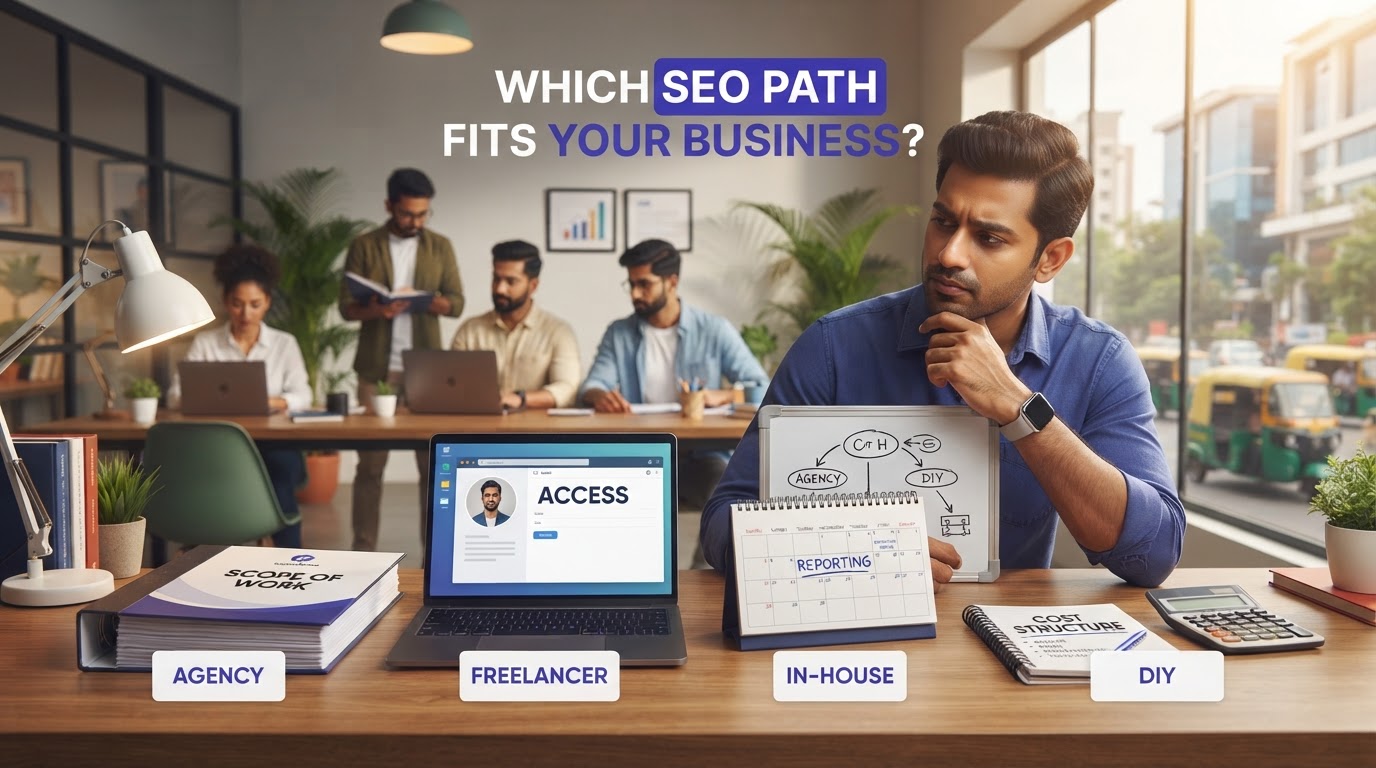
How to Choose SEO Services: Agency, Freelancer, In-House, or DIY?
Quick answer: which SEO option fits your business?
Choose SEO services based on four things: the work you need done, the time you can give it, the control you want to keep, and the budget structure you can manage.
- DIY SEO can fit when you have time to learn, can edit your website, and want to handle the work yourself.
- An SEO freelancer can fit when you need focused specialist support without building a full internal team.
- An SEO agency can fit when your plan needs several skills or more structured delivery.
- An in-house SEO hire can fit when SEO needs close, day-to-day coordination with your business.
- An AI-assisted content solution can fit when publishing useful, search-focused content is one part of the plan and you still understand what other SEO work is needed.
There is no universal best choice. A local service business with a small website may need something very different from an online seller with many product pages. The right option is the one that clearly covers your current needs without making you pay for work you do not need or leaving important work unassigned.
Start with the outcome, not the provider label
Before comparing agencies, freelancers, tools, or job candidates, decide what you want your website to help customers do. That could be sending an enquiry, making a phone call, visiting a physical location, starting a WhatsApp conversation, or placing an order.
Then write down the work required to support that outcome. Your list may include:
- Creating and improving website content
- Fixing technical website issues
- Improving page titles, headings, internal links, and other on-page elements
- Supporting local search visibility for a location-based business
- Tracking results and reporting on the work
- Coordinating changes with a web developer or ecommerce team
This step matters because "SEO services" can mean very different things. One proposal may cover content only. Another may include technical checks, local business profile work, and coordination with developers. Neither is automatically better, but they are not the same scope.
Also keep SEO separate from paid Google Ads when comparing proposals. SEO is work intended to improve how a website is understood and found in unpaid search results. Google Ads is paid advertising with its own campaign setup, budget, landing pages, and measurement. A provider may offer both, but ask for each scope and each cost separately. That makes it easier to compare like for like.
Option 1: Do SEO yourself
Doing SEO yourself may suit an owner who has a simple site, knows the business and customers well, and can consistently set aside time for the work. It can also be a sensible starting point when your immediate goal is to understand the basics before outsourcing.
The tradeoff is clear: you keep control, but you also keep the responsibility. You decide what to publish, check whether pages are accurate, make or request website changes, and review whether the work is supporting the business goal.
Use this practical checklist before choosing DIY SEO:
- Do you have regular time for learning and implementation, not just a one-time afternoon?
- Can you access your website, or can someone make changes when needed?
- Can you create useful pages or articles based on real customer questions?
- Can you collect the information needed for service pages, product pages, and location pages?
- Can you review basic performance data and decide what to improve next?
- Can you keep the work going after the first burst of motivation?
DIY does not mean doing everything alone. You may still need a developer for website changes, a writer for larger content projects, or an expert review for technical issues. The key is to identify those dependencies before you commit to owner-led SEO.
DIY is less suitable when your website needs frequent technical changes, when your business has many pages to manage, or when you cannot give the work consistent attention. In those situations, the cost is not only money. It is also the opportunity cost of work that stays unfinished.
Option 2: Hire an SEO freelancer
An SEO freelancer can be a good middle ground when you need a specialist for a defined scope. For example, you may need help planning content, improving existing pages, auditing technical issues, or handling local SEO work. A freelancer may also offer more direct communication than a larger provider.
However, a title alone does not tell you what the person can deliver. SEO includes different types of work, and one freelancer may focus on content while another focuses on technical implementation. Availability can matter too, especially if your plan depends on regular publishing or quick coordination with a developer.
Ask these questions before hiring:
- What specific deliverables will you provide each month or for this project?
- Which parts of the work will you do yourself, and which parts need my team, writer, or developer?
- How do you decide which pages or topics to prioritise?
- Can you make technical changes, or will you provide recommendations only?
- How often will we communicate, and who is my point of contact?
- What will your report show, and how will it connect back to my business goal?
- Who owns the website accounts, documents, content files, and tracking setup?
Look for clear answers, not impressive vocabulary. If a freelancer promises an outcome without explaining the work, the timeline, or the inputs required from your side, you will struggle to manage expectations later.
Option 3: Work with an SEO agency
An SEO agency can fit when your SEO plan needs broader support. An agency may be able to bring together people working on strategy, content, technical issues, reporting, and project management. This can be useful if you do not want to coordinate several separate specialists yourself.
The tradeoff is that an agency name does not explain who will actually work on your account. Ask how the team is structured, who will attend meetings, and whether the work is handled by the people you speak with or passed to another team.
Review an agency proposal with these points in mind:
- Scope: Which tasks are included, and how many pages, pieces of content, audits, or recommendations does that mean?
- People: Who is responsible for strategy, delivery, communication, and technical work?
- Approvals: What needs your approval before it is published or changed?
- Access: What access does the agency need, and can you control it appropriately?
- Reporting: What will be reported, how often, and what decisions should the report help you make?
- Website work: Will the agency implement changes, work with your developer, or only send a list of recommendations?
- Contract terms: What is the commitment period, how can either side end the engagement, and what happens to unfinished work?
An agency can be the better fit when coordinated delivery is more valuable than having one individual handle every task. But do not assume "full service" means every part of SEO is included. Ask for the scope in writing.
Option 4: Build an in-house SEO role
An in-house SEO role can make sense when search work needs close coordination with product, sales, content, ecommerce, customer support, and web teams. A person inside the business may have faster access to product information, customer questions, and internal approvals.
But hiring is only the first part. You also need to define ownership, give the person access to the right systems, set a workable approval process, and decide who will implement technical recommendations. Depending on the role, you may also need content support, design support, developer time, and SEO tools.
Consider a dedicated role when the expected workload is continuous and substantial enough to justify it. If the work is occasional, narrowly focused, or mostly dependent on outside development help, a full-time hire may not be the most practical first move.
Ask yourself:
- Is there enough ongoing work for a dedicated person?
- Will this person have authority to prioritise changes?
- Who will provide business knowledge and approve content?
- Who will handle development work that the SEO role identifies?
- Can you manage and evaluate the role with clear goals?
An in-house role can provide ownership and proximity to the business. It also requires management attention and a workflow that lets the person act on what they find.
Option 5: Use an AI-assisted content solution
An AI-assisted content workflow can fit when content is an important part of your SEO plan and you need help producing search-focused drafts or planning what to publish. It can be useful for businesses that have expertise to contribute but need a more structured way to turn customer questions and business topics into website content.
It is not automatically a complete SEO solution. Content is only one possible part of SEO. A tool may not handle technical website issues, local visibility tasks, developer coordination, publishing, quality review, or business-level prioritisation unless those services are explicitly included.
Before treating any AI-assisted option as part of your plan, ask:
- How is the content strategy decided?
- What information will the tool or provider need from my business?
- Who reviews drafts for accuracy, customer fit, and brand voice?
- Who publishes the content and checks the final page?
- Does the scope include technical SEO work or only content?
- Who is accountable for reporting, decisions, and next steps?
Brand Banao is built around SEO-focused content for businesses that want to attract Google search visitors. Consider it as a content-focused option within a wider SEO plan, then confirm what additional work your website needs.
Use one comparison checklist before you choose
Compare every option using the same checklist. This prevents you from choosing based only on a monthly price or a persuasive sales call.
| Criteria | What to confirm |
|---|---|
| Goals | What customer action is the SEO work meant to support? |
| Scope | What tasks, pages, content, technical work, and local work are included? |
| Price structure | Is the cost project-based, monthly, hourly, salary-based, or tied to tools and outside support? |
| Access | Which website, analytics, business profile, and advertising accounts are needed? |
| Ownership | Who owns accounts, content files, reports, and website assets? |
| Communication | Who is your contact, and how often will you speak? |
| Reporting | What will be measured and explained? |
| Approval process | What requires your sign-off before publication or implementation? |
| Exit terms | How can the arrangement end, and what work or access remains with you? |
Ask every provider, candidate, or platform to state what is not included, not only what is included. That one question can reveal gaps such as publishing, developer implementation, revisions, local work, tracking setup, or ongoing content updates.
Make the decision and set the first review point
Choose the option that matches your current scope and internal capacity. You do not need to solve every future SEO need on day one. Start with the work that is most important now, assign responsibilities clearly, and avoid leaving any critical task assumed rather than owned.
Document who will provide business inputs, who will create content, who will approve changes, who will publish or implement them, and who will review results. Then set a first review date. At that review, assess whether the scope still fits, whether responsibilities are working, and whether you need more or different support.
Your choice can change as the business changes. Use the same comparison checklist when you add a developer, bring work in-house, hire a freelancer, switch agencies, or expand content production.
Use the checklist to define your SEO content needs, then see whether Brand Banao fits your plan.